forthcoming
Canopy Study #1
Photography & site record.
03 — Art in the Forest
Forest thinking sees no line
between the tended and the beautiful.
Land Art & Ephemeral Sculpture
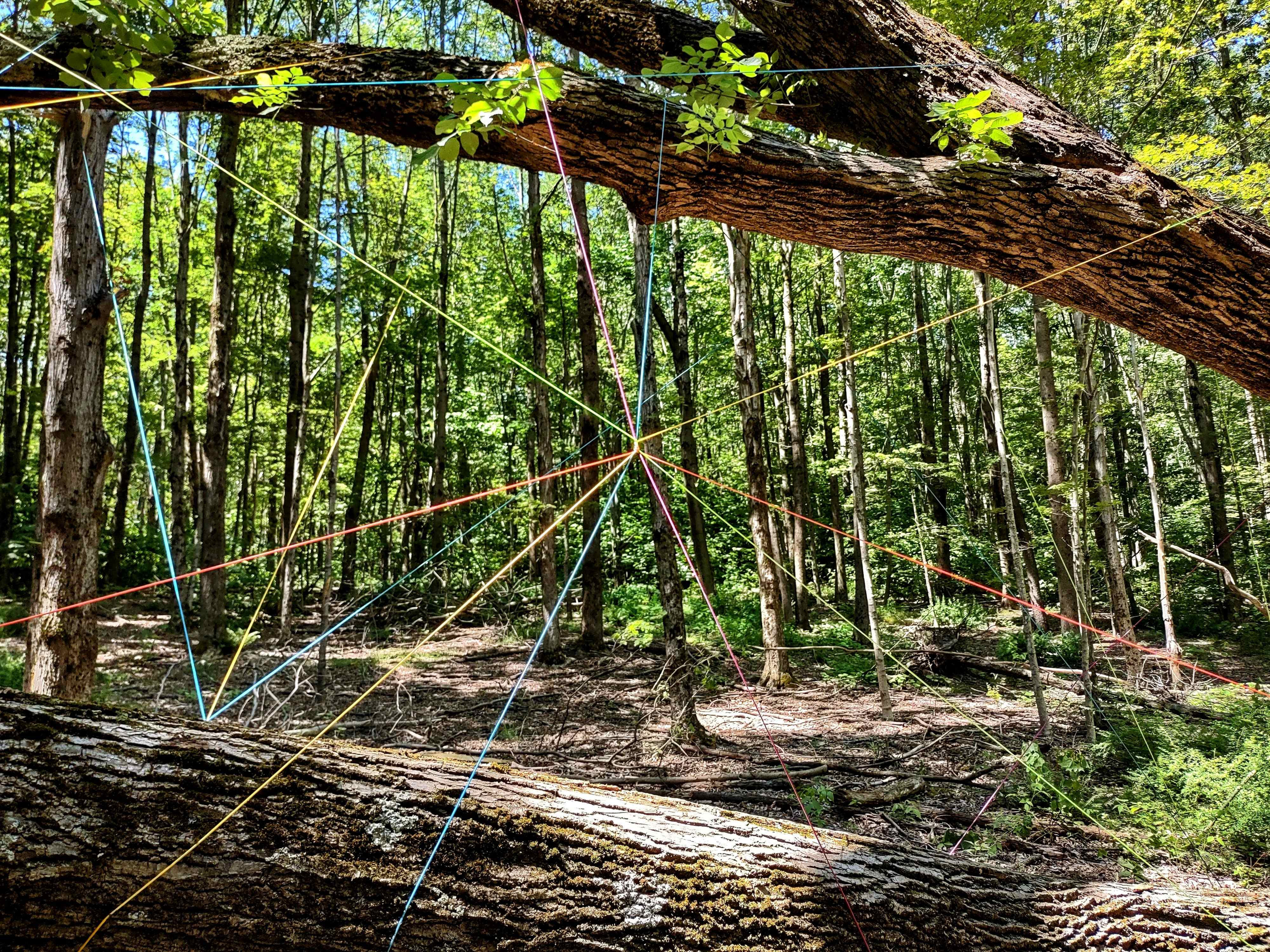
There is a lineage of artists who went to the land and made work from what they found there. Goldsworthy stacking ice, arranging leaves, coiling sticks in still water. Smithson mapping entropy into enormous earthworks. Nils-Udo nesting forms inside the forest as if the forest had dreamed them. Nancy Holt turning light and shadow into astronomical instruments. What these artists shared was a refusal to treat the landscape as backdrop — they understood it as collaborator, as material, as force.
The art practice here is just beginning, and it starts with something small. A fallen ash tree. Colored rope radiating outward from a single point on the log. It took about an hour to make, with two people, using materials that were already on site. The choice of ash is not incidental, but it wasn't calculated either — the tree was there, the form suggested itself. What makes it quietly thematic is what the rest of this site records about ash: that the species is in collapse across the northeastern forest, that what happens to fallen ash wood is part of what forest stewardship now involves. The rope marks the tree rather than mourning it. The ash is becoming material, the way ash on this land is gradually being asked to do.
More work will come. The form it takes will grow from specific knowledge of specific places — the clearing that already functions as a room, the stone wall running deep into second growth, the stretch of stream that performs differently in every season. A well-tended forest is already a composition. What comes next here makes that legible. A cairn placed in a stream is a sculpture. It's also a check on water level. A spiral of fallen leaves documents the wind. Every forest artwork is also data. Every act of care is also composition.
Leaf Spiral Study — an Archimedean arrangement of 55 leaves, as they might be placed and found.
Geometric Light Installations
The geometric light work that has been developing under the name Radiant Arrays will find its most resonant setting here, in this forest. Light changes everything in a woodland: the canopy filters and fractures it, moving leaves strobe it, canopy gaps concentrate it into shafts that shift through the day like slow spotlights. The forest is already doing something with light — the work planned here extends that logic with explicit geometric intention.
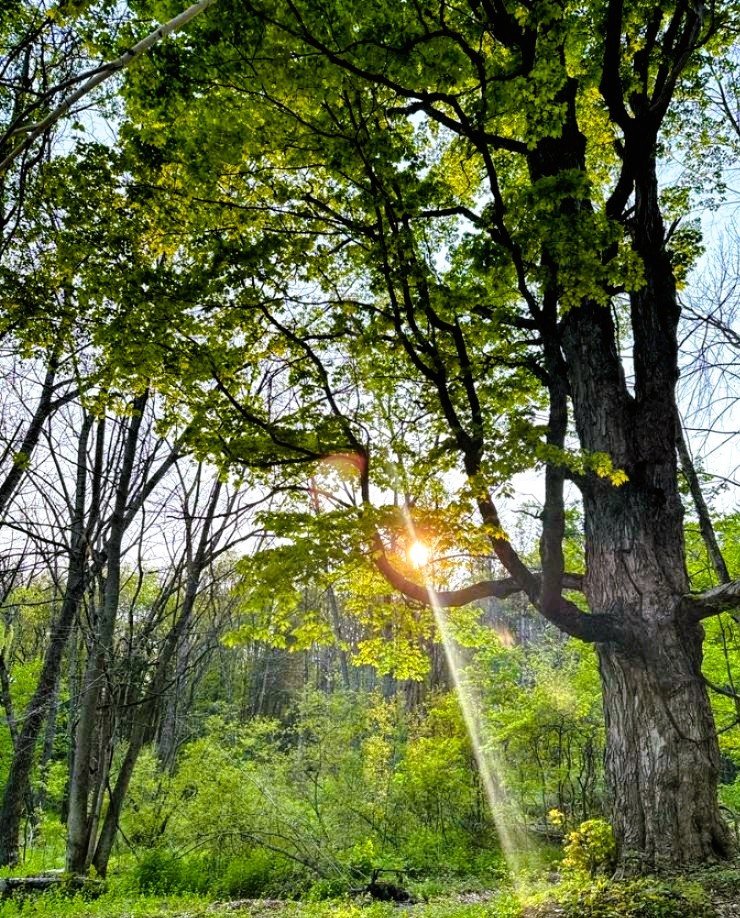
The installations take the form of nail-and-wood panels: precise arrangements of nails in geometric patterns on weathered board, strung with monofilament or fine wire that catches light differently at different angles and times of day. Positioned at points where light enters the forest — at canopy gaps, along stream corridors, on south-facing clearing edges — the panels interact with natural light through the day and through seasons. At dawn they catch one color temperature. At noon another. In winter low-angle light the geometry shifts completely. The same panel never looks the same twice.
Temporary artificial installations will explore the forest at night: arrays of warm light sources mounted in the understory, revealing spatial relationships that daylight and shadow normally hide. The structure of the forest — its layering, its lateral patterning, its depth — becomes legible in a different way when illuminated from within rather than from above. The nail-and-wood substrate in these installations echoes bark and branch texture; the geometry echoes the growth patterns of the trees themselves.
Click anywhere in the forest to place a light source
The Forest as Medium
The forest provides material in abundance. Stone from the stream corridor and ridge outcrops. Branches from storm damage and selective removal. Bark and root systems from trees that fall in their own time. Ice in winter — one of the most responsive and beautiful materials available, requiring only temperature and water and a cold night. Moss, which attaches itself to placed stones and records the moisture regime of its location over years.
Working with found materials means working with time. Ice documents temperature — a form made from the water column of a particular winter night melts when that winter ends. Cairns constructed from stream stones document water level across seasons: the moss line, the high-water debris, the staining of the stone all accumulate as a record of what the water has done. A spiral of fallen leaves made in late October, when the maples have dropped first and the oaks are still holding, is a document of that specific forest community in that specific year. The work keeps notes that other methods cannot.
This temporality is not a limitation. It's the point. When you make something that the forest will disassemble — the ice that melts, the leaf arrangement that the wind rearranges, the stick structure that the snow compresses — you are practicing the same acceptance that good stewardship requires. The forest has its own agenda, its own timescales, its own sense of composition. Stewardship and making share the same gesture: picking something up, placing it with care, and accepting that the forest will have the last word about how long it stays.
Reference & Inspiration
Kathy Klein works with flowers. More precisely: she kneels on the ground — in parks, in gardens, in open land — and arranges petals, seeds, leaves, and botanical fragments into mandalas of intricate geometric symmetry made entirely from what grows. She calls this practice danmala, from Sanskrit: garland gift. The mandalas are not constructed so much as they emerge, through a process Klein describes as moving meditation. When the work is complete, it is photographed, and then its materials are returned to the ground.
What makes this work significant — beyond its visual beauty, which is extraordinary — is the insistence that precision and impermanence are not opposites. A danmala is as exact as a technical drawing: each petal placed, each ring calibrated, each axis of symmetry honored. And then it is released. What the flowers were briefly holding is given back to the earth. The geometry was real. It is now gone. This is not a statement about futility — it is a practice of understanding that beauty is a temporary alignment of things that were always going somewhere else. The mandala form itself, radially symmetric and endlessly recursive, appears across cultures and across millennia precisely because it describes something true about how complexity organizes itself around a center. Klein speaks it in the only materials that have always grown inside it.
For a forest project grounded in the idea that tending and making share the same gesture, this work is a model and a point of orientation. The forest provides its own danmala materials in every season: petals from the spring ephemerals — trout lily, hepatica, trillium — in the window before the canopy closes; seeds and husks from the nut trees in fall; lichen pulled from north-facing stones; feathers, bark scale, river-smoothed gravel, ice from the stream in February. These are precisely what the practice uses. A gathering here that included the making of a botanical mandala on the forest floor would be both an aesthetic event and a form of close attention to what this specific place contains at this specific moment in the season. That the mandala would be dispersed by rain or rearranged by wind is not a loss. The forest knows how to do this. It has been doing it for ten thousand years. Danmala practice in a forest context is forest thinking expressed as offering — making something intricate and precise from what the land provides, and then giving it back to the land's own ground.
Botanical mandala — leaf, petal, sprig, and seed — assembled in the danmala manner. Each ring composes into place. Like the practice itself, it is held and then released.
"Precision and impermanence are not opposites. They are the same practice — the same quality of attention, directed toward making and then toward letting go."
Planned Installation
Straight timber, nailed angles, and precise geometry — ascending the full length of the property from entrance to ridge.
Meridian will be a single continuous structure running the full extent of the property — from the entrance at the valley floor to the far reach of the ridge. It will be built from the forest's own discards: the straight young trees and clean branches removed during stand improvement work, material that would otherwise be piled as slash. That wood will be measured, cut to length, and attached with iron hardware directly to the trunks of existing trees, creating a connected geometric framework that moves through the living forest without any posts in the ground.
The geometry is the point. The forest is a world of curves: trunk flare and crown arc, the spiral of bark, the irregular spread of branches. Meridian introduces something the forest does not naturally contain — precise angles, true horizontals, straight lines that extend further than any branch and hold their direction regardless of what the canopy does above. Moving sideways and angling upward in a series of connected spans, the structure will read differently depending on where you stand: from below the entrance you see a receding line; from the mid-slope you see a web of angles between trunks; from the ridge, looking back down, you see the whole thing converge.
The installation will not be lit, elevated, or interpreted with signage. It will simply be there, attaching itself to the trees with nails and brackets, occupying the same light and weather as everything else in the forest. Visitors will encounter it incidentally — walking an existing trail — and will pass through it rather than standing apart from it to look. The experience is meant to be spatial and physical, something understood through movement. The geometry resolves itself slowly as you walk. By the time you understand what it is, you're already inside it.
Over time, Meridian will change. The wood will check and gray. Moss will take hold at the connection points where moisture collects. The trees it attaches to will grow, and the bark will slowly begin to close around the hardware. Some sections will loosen and need re-fastening; others will hold for decades. The structure is not meant to be permanent — but it is meant to outlast the attention span of a single visit, to become a feature of this forest that returning visitors will watch age.
Gallery
These are the works that will be made here. The titles exist before the objects do — which is itself a form of forest thinking, a way of naming the attention before directing it. As works are created and documented, this gallery will grow. Like the forest itself, it develops on its own schedule.
Photography & site record.
Stone, water, seasonal record.
Nail-and-wood panel, low-angle light.
Found material, forest floor.
Leaf arrangement, fallen oak.
Radiant Arrays panel, canopy gap.
An Open Invitation
Artists interested in making work in this forest are invited to get in touch.
The land holds places that are waiting for someone to notice them the right way — a clearing that already resembles an outdoor room, a stone wall running deep into second-growth woods, a stretch of stream that performs differently in every season. Adaptation Forest does not have a formal residency program, and probably won't. What it has is access: to a working landscape that takes art seriously as a form of care, to site-appropriate materials, and to a trail network that can make finished work genuinely visitable.
The offer is simple. If you are working in land art, ephemeral sculpture, sound, light, or any practice that belongs outdoors and in dialogue with a specific place, write and describe what you are thinking about. If the idea fits the forest and the forest fits the idea, we can find a way to host it. Work that succeeds on the land will be documented and featured in the gallery above, and the trail network will be adjusted, where it makes sense, to bring visitors to it.
There is no fee to use the site, and there is no stipend. Materials found on site — fallen timber, stone, seasonal plant matter — are generally available. Materials that need to be brought in are the artist's responsibility, as is the eventual removal of anything that isn't meant to stay. What the forest offers is time, attention, and a place that will keep working on the piece after the artist leaves.
Write to
info@adaptationforest.orgA few paragraphs about the work you have in mind is enough to start the conversation. Images or links if you have them.